OPTARI
OPToacoustic imaging toolkit based on napARI: an open-source desktop application for analyzing clinical photoacoustic/optoacoustic (OA) and ultrasound (US) studies.
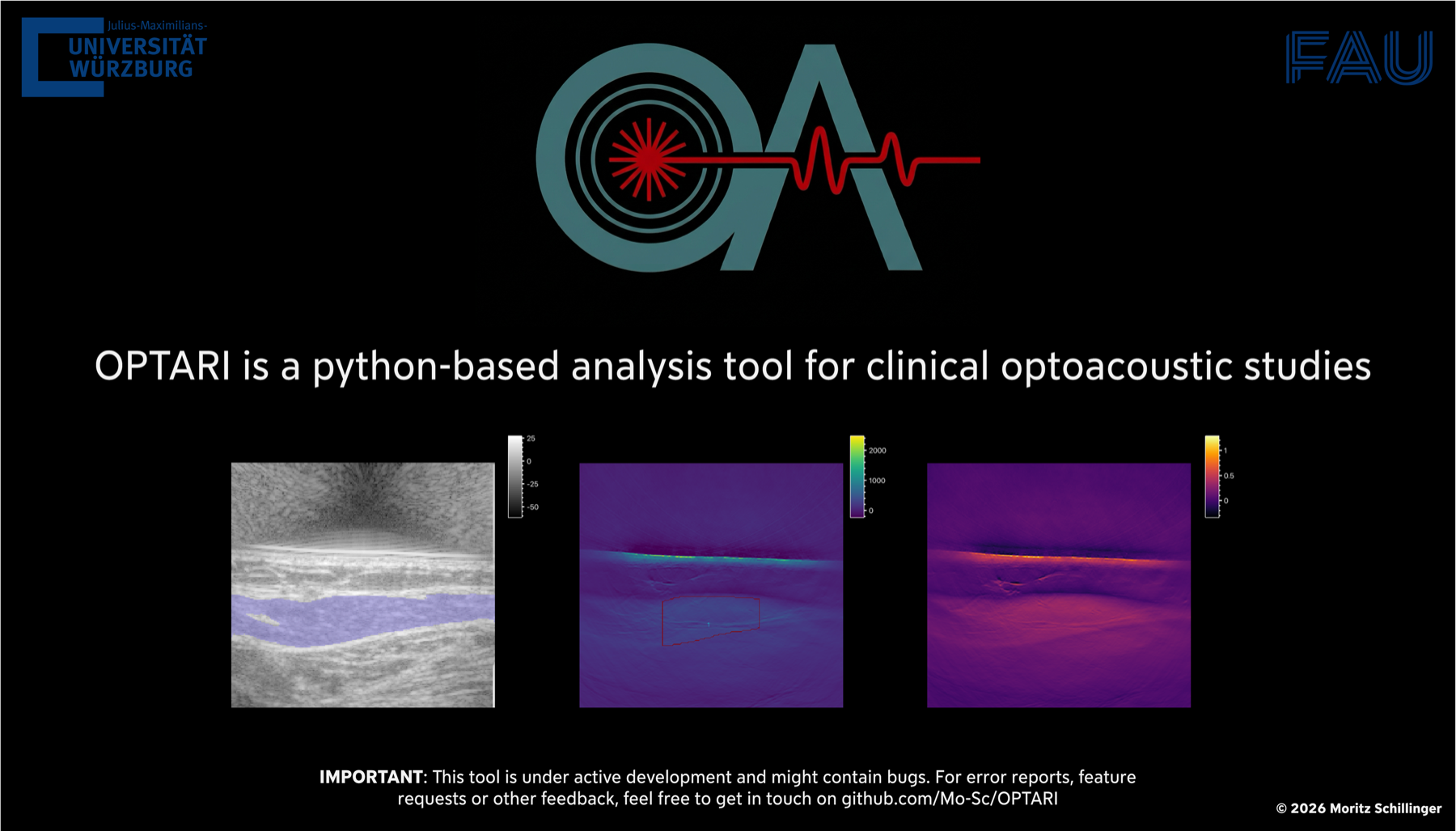
OPTARI is an attempt to close the gap between engineering frameworks and clinical research in OA imaging. It combines a custom version of PATATO for data I/O and processing with napari for multi-layer image visualization, then adds a multi-patient study workflow, ROI annotation, automated tissue segmentation, and analysis tools required for clinical OA studies.
Supported scan formats:
- PATATO HDF5
- IPASC HDF5
- iThera MSOT Acuity Echo
- iThera Frontier (upcoming)
-
First Time: Read the publication and start with Installation. Download the test scans.
-
Using OPTARI: Read the User Guide and see Sample Workflows examples.
-
Configuration: Learn how to customize OPTARI and configure reconstruction, unmixing and segmentation adapters.
-
Contributing: Read the Architecture and Contributing pages, as well as the API reference.
Scope of OPTARI
Most existing tools for OA-US analysis are either hardware-locked vendor software, or script-based engineering frameworks aimed at algorithmic research. They are not intended for fast, multi-patient workflows in clinical studies. OPTARI is built specifically as a graphical, non-programming interface that is intuitive to use and assists clinicians with automatic parameter selection and shareable configurations.
Note
OPTARI is research software intended for the analysis of data from clinical studies and has not undergone assessment as a medical device. It is not intended for diagnosis or treatment decisions.
Key Features
- Visualize US + OA scans from different clinical scanners.
- Browse multi-subject, multi-scan studies with fast switching and scrolling through frames/wavelengths.
- Draw, edit, and save ROIs, reuse them via a shareable ROI Library.
- Extract ROI intensities, plot ROI intensities over time and wavelength.
- AI-based tissue segmentation with automatic ROI placement.
- Reconstruction and spectral unmixing using PATATO and DeepMB, directly from the GUI.
- Load iThera
.msot, PATATO HDF5, and IPASC HDF5 scans. - Export to CSV/XLSX, open HDF5 with IPASC metadata, native IPASC raw data, or PNG/TIFF.
Project Status
OPTARI is under active development. The source code, standalone installers, and example scans are available on GitHub under the BSD-3-Clause license. Contributions and issue reports are welcome (see Contributing). For license, citation, and funding information, see Citing.